
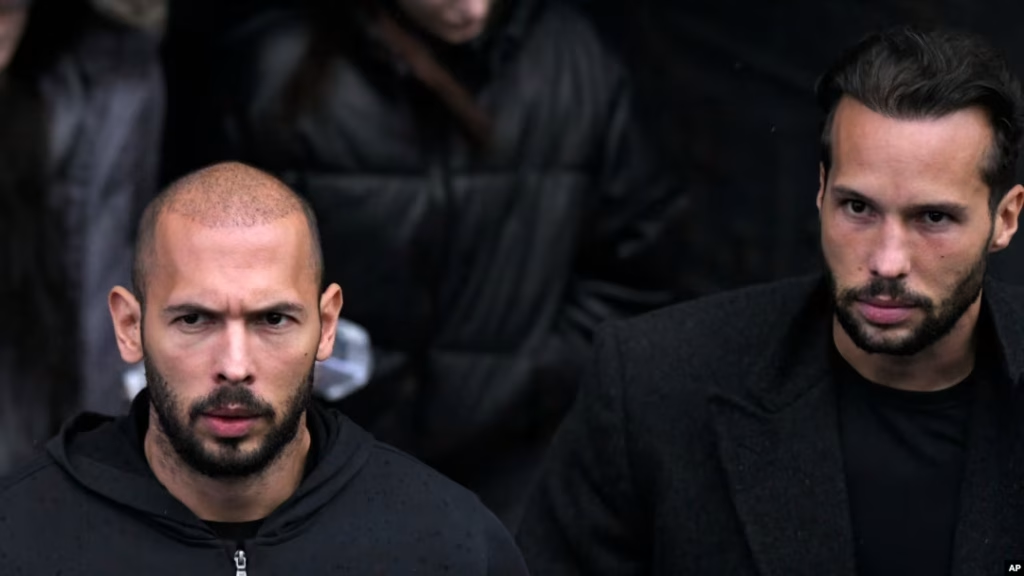
In 2024 the International Consortium of Investigative Journalists (ICIJ) obtained leaked records from Paxum Bank, a small bank based in Dominica that serves the pornography and adult services industries. Among them sits a statement for an account held by Tristan Tate, the social media personality and business partner of his brother Andrew Tate. The statement covers 2017 to 2024, and its numbers tell a clear story: close to $2.8 million deposited, of which about $2.6 million came from MFCXY Inc., a Florida-based company hosting an adult webcam platform, with smaller sums arriving from other adult content sites including OnlyFans.
The payments ran until August 2022. Four months later, in December 2022, Romanian authorities arrested both brothers on suspicion of rape, human trafficking and forming a criminal group to exploit women. Prosecutors allege that seven women were forced through violence and psychological coercion to perform sexual acts on camera. The brothers deny every allegation. Tristan Tate has described his former webcam business as a legal streaming studio whose workers were content, and he says he left it years before the Romanian charges were brought. ICIJ states that any connection between these transactions and the criminal cases remains an open question, and this piece holds to that same line.
What the records establish with clarity is the route the money travelled. Over the period, 183 wire transfers carried funds out of the Paxum account into accounts Tate held in Romania and the United Kingdom, at Raiffeisen Bank Romania, HSBC and Santander UK. Paxum belongs to the SWIFT international payments network, and through that membership a bank that mainstream institutions keep at arm’s length still reaches directly into their systems. ICIJ leaves the receiving banks outside any claim of knowledge about where the funds originated. Santander and HSBC cited customer confidentiality. Raiffeisen described a compliance framework that analyses suspicious transactions, reports them where warranted, and ends client relationships when an account raises concern.
Here the question widens to the architecture we all live inside. Kathryn Westmore, senior research fellow at the Centre for Financial Crime and Security at RUSI in London, told ICIJ that transactions of this kind call for high-risk classification and enhanced monitoring, and that their link to an adult webcam company should prompt a close look at the source of the funds to establish whether any of it came from illegal activity or illicit content. Many banks, she added, would place such an account far beyond their risk appetite and move to exit it quickly. Her assessment names a duty at the heart of a values-driven financial system: every institution that moves money also carries a share of responsibility for the human reality that money comes from.
Paxum’s own profile deepens the picture. The bank is owned by Anton Postolnikov, a Russian-American entrepreneur who became a major investor in Digital World Acquisition Corp., the vehicle that merged with Trump Media. The Guardian has reported on a trust with links to Postolnikov and a Paxum account that lent $8 million to Truth Social. Paxum declined ICIJ’s detailed questions, stated that the law bars it from disclosing customer information, called any suggestion of a current investigation into Postolnikov meritless, and sent a letter through a Dominica-based lawyer warning of legal consequences for publishing confidential bank data.
Since ICIJ published its findings, the legal situation has moved considerably. Both brothers were arrested in Miami on 18 July 2026 following a United Kingdom extradition request, and they remain in US custody while contesting extradition; in the UK they face 59 criminal charges, among them rape, sexual assault and facilitating trafficking for sexual exploitation, while separate proceedings continue in Romania. The brothers have denied all charges and allegations. They are entitled to a fair trial and the presumption of innocence, and the courts will establish the facts. OHCHRWikipedia
For a society that places human dignity at its foundation, the lesson reaches past this single case. Money holds the imprint of the labour and the bodies that produced it, and a financial system worthy of trust reads that imprint carefully at every point where money changes hands. Webcam platforms, niche banks and global institutions each hold a link in the chain, and the strength of the whole depends on the attention each one brings to its own link. Transparency, due diligence and the courage to ask where money comes from are the practical form that respect for human dignity takes inside a bank.
Based on reporting by Matei Rosca for ICIJ, published 7 May 2024. Adapted and republished with permission.